Juvenile Justice Reform

Montgomery County Partnership Targeting Youth with Substance Abuse Issues

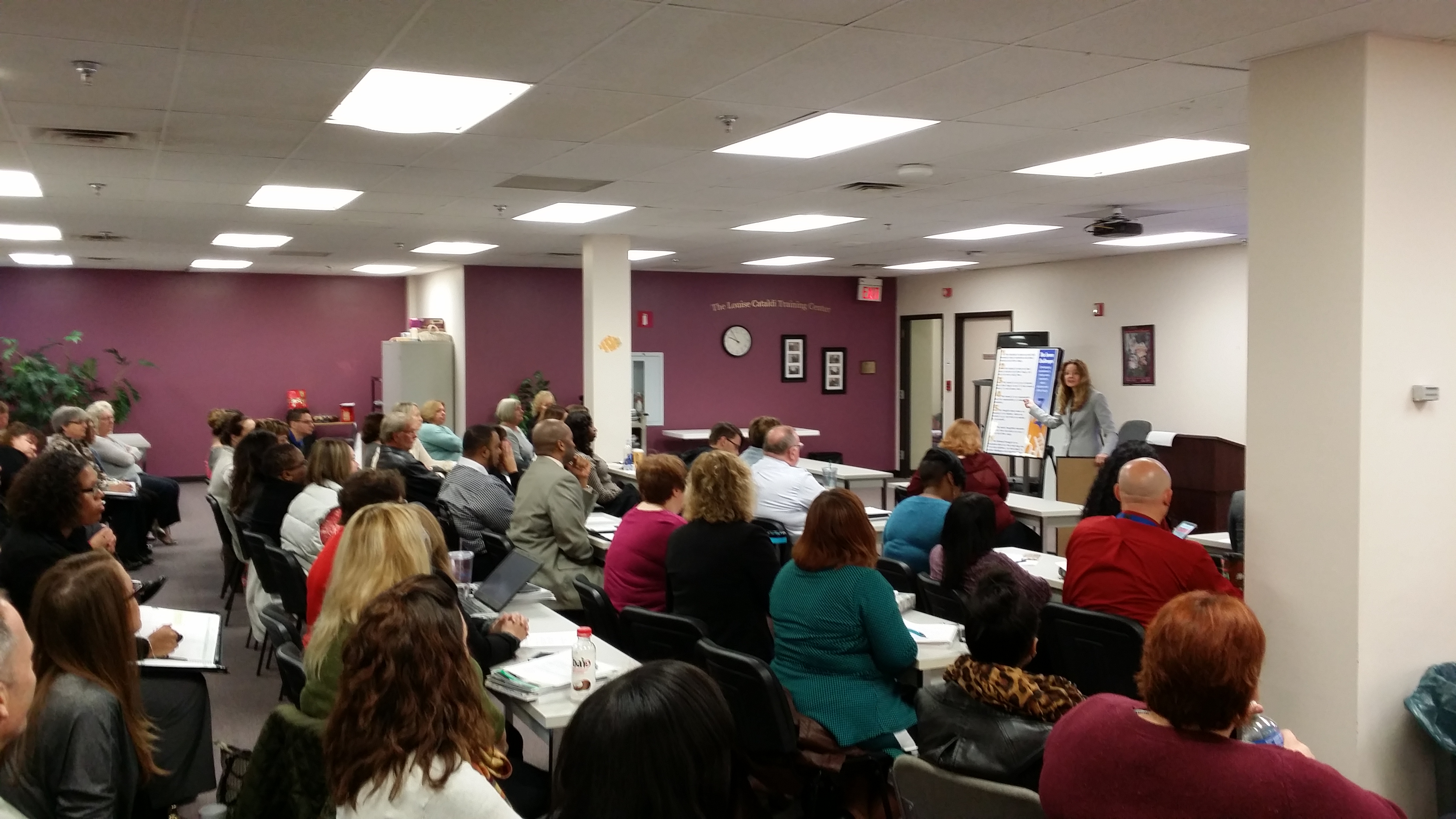
Cassandra Russell, national trainer for The Seven Challenges, presents

On Wednesday, October 22, 2014, Montgomery County Juvenile Court, South Community Inc., along with the support of the Ohio Department of Youth Services, hosted a community overview to kick off the expansion of much needed outpatient adolescent substance abuse and co-occurring treatment in the community! South Community, Inc., a private behavioral health group, and Montgomery County Juvenile Court collaborated to bring the program, The Seven Challenges, to the area.

Judge Nick Kuntz and Judge Anthony Capizzi commended Juvenile Court and South Community staff for their efforts and working together to bring evidence-based treatment options to the youth of Montgomery County. The Seven Challenges is an evidence-based model supported by the National Substance Abuse and Mental Health Services Administration, and is designed to motivate a decision and commitment to change among adolescents struggling with substance abuse.

Cassandra Russell, a national trainer for The Seven Challenges, provided an overview during the community kick off. The initial training and implementation of The Seven Challenges was funded through the Ohio Department of Youth Services. Continued funding is provided through the Office of Juvenile Justice and Delinquency Prevention Drug Court Enhancement grant until October 2017.

Webinar Opportunity: Exercising Judicial Leadership on the Deinstitutionalization of Status Offenders

JudgeThe Coalition for Juvenile Justice (CJJ) will host a webinar on November 14 to address how judges can more effectively bring together family members, attorneys and advocates, and service providers to improve outcomes for non-delinquent youth in their communities.

Targeted to judicial leaders and juvenile justice practitioners, the webinar will offer actionable steps on how to convene stakeholders involved in the youth’s life, and will expand on the recently released CJJ tool relevant to judges in this area: “Exercising Judicial Leadership to Reform the Care of Non-Delinquent Youth: A Convenor's Action Guide for Developing a Multi-Stakeholder Process.”

The report explains,

“Juvenile judges and courts face complex challenges as a result of laws that allow youth, by virtue of their minor status, to be charged in juvenile court with ‘status offenses.’ Status offenses are actions that are not illegal after a person reaches the age of 18. They include curfew violations, possession of alcohol and tobacco, running away and truancy. All too often the court’s involvement in the lives of these youth and families does not yield the intended positive outcomes, particularly when youth charged with status offenses have their liberty restricted and lives disrupted by being placed in confinement, and are separated from their family, school and community.”

Register for this webinar to hear directly from two judges who have seen success and made a difference in the lives of status offending youths and families.

Webinar: Exercising Judicial Leadership on the Deinstitutionalization of Status Offenders
When: November 14 at 1:00 p.m. ET
Presenters: Hon. Chandlee Johnson Kuhn, Chief Judge, Family Court of Delaware; Hon. Karen Ashby, Judge, Denver Juvenile Court
Register here.

Examining Collateral Consequence Laws: Do They Promote or Deter Recidivism?

isolationA recent report by William & Mary Assistant Professor Tracy Sohoni called “The Effect of Collateral Consequence Laws on State Rates of Returns to Prisons” examined whether collateral consequence laws effectively prevent crime or simply make it more difficult for past offenders to successfully re-enter society.

Collateral consequence laws are legal sanctions and restrictions imposed upon people because of their criminal record, and Tracy Sohoni believes they are doing more harm than good.

The report states about 70,000 people are released from prisons annually and roughly two-thirds are rearrested within three years of release. Sohoni hypothesizes that this is due to the restrictions brought on by the laws, which can make it difficult for past offenders to get welfare, vote, obtain a drivers license, and find stable housing and employment.

“Ex-convicts need structural opportunities. They need jobs,” Sohoni said. “A lot of offenders come out and want to live a productive life but a lot of them find the opportunities just aren’t there.”

The research did not find statically significant relationships between collateral consequence laws and state returns to prison, but in specific cases where more data was available, Sohoni did link increases in rates of returns to prison to the restriction in question. Such was the case with her evaluation of restricted access to Temporary Assistance for Needy Families (TANF).

The report highlights that collateral consequence laws have often been called “invisible punishments” because they aren’t broadly publicized or well known—something that is beginning to change. In 2012, Congress directed the National Institute of Justice to collect and study collateral consequences in all U.S. jurisdictions, and the ABA Criminal Justice Section was appointed to do the necessary research and analysis to create a new online database.

Sohoni, as reported by the Chicago Bureau, acknowledged that the lack of wide data at this time and other factors make it impossible to draw absolute conclusions on the direct impact these laws have. However, the results can still serve as support for those advocating for “less severe punishments, a rollback of the harsh laws from 20 and 30 years ago and the relaxation of laws that haunt inmates after release, often precluding them from re-entering society in any meaningful way.”

Reclaiming Futures Featured on the Office of National Drug Control Policy Blog

In recognition of National Substance Abuse Prevention Month, I had the honor to contribute to the Office of National Drug Control Policy’s blog. Citing our Reclaiming Futures site in Snohomish County, Washington, I shared why we at Reclaiming Futures believe community involvement is critical to improve mental health and substance abuse treatment, and ultimately build stronger communities around prevention.

Read the full blog post here and contribute your thoughts below.

In Juvenile Justice, Community Involvement is Key to Substance Abuse Prevention

Local artists in Snohomish County, Washington, are contributing their time, tools, and studio space to mentor teens recently involved in their community’s juvenile justice system. For eight weeks, the youth will learn art and photography skills, then produce artwork documenting their lives, families, and communities. Some of their efforts will be featured in local art venues or the local newspaper.

The teens are participants in Promising Arts in Recovery (PAIR), part of Snohomish County’s local Reclaiming Futures program. The goal of PAIR is to establish social and job skills by connecting local artists with at-risk teens who are involved in the juvenile justice system and may be undergoing treatment for substance use or mental health issues. Through programs like PAIR that offer workshops, internships, or job-shadowing opportunities, local professionals are not only helping these young people develop skills necessary to be active citizens, they are helping to rebuild a community around prevention.

Read the full story.

40 Stories for 40 Years: Celebrating the 40th Anniversary of the Juvenile Justice and Delinquency Prevention Act

Screen Shot 2014-09-19 at 11.41.03 AMThis month marks 40 years since the Juvenile Justice and Delinquency Prevention Act (JJDPA) transformed youth justice. The JJDPA, considered one of the most important pieces of legislation for youth justice, established four core protections for young people in the system and set basic standards for state systems:

  1. Deinstitutionalization of Status Offenders (DSO);
  2. Adult Jail and Lock-Up Removal (Jail Removal);
  3. Sight and Sound Separation; and
  4. Disproportionate Minority Contact (DMC).

The JJDPA allows states, which meet these four requirements, to do the following:

  • Fund innovations and reforms that keep more kids out of jails and detention facilities and connected to safe, proven supports in their communities.
  • Modernize and improve their programs to give kids the supports they need to get their lives back on track and help make communities safer.

In celebration of the JJDPA’s 40th Anniversary, SparkAction, the Act 4 Juvenile Justice Campaign of the National Juvenile Justice and Delinquency Prevention Coalition (NJJDPC), and local organizations across the country are coming together to collect 40 short videos that “use real lives and real voices to illustrate the policy and systems impact of the JJDPA.”

Throughout the fall, catch 40 new personal stories covering the impact of the JJDPA, ways it can be strengthened and improved, and how you can get involved!

The goal for the “40 stories for the 40 years of the JJDPA” campaign is to mobilize support for a Congressional reauthorization that improves and strengthens this landmark law to support states in designing fairer, more effective local approaches.

Webinar: Increasing Family Voice in the Juvenile Justice System

Why is a family voice significant in the juvenile justice system? I’m addressing this question in aOlivia September 19 webinar, along with Sandra Spencer of the National Federation of Families for Children's Mental Health.

We’ll discuss why family voice is crucial to the success of and support of youth involved in the juvenile justice system. As an advocate for substance abuse and mental health treatment for teens, Reclaiming Futures helps families connect to the community support resources needed for adolescents to stay clean and sober, and become a productive member of society.

Here are three takeaways you’ll gain from attending this webinar:

  • Understand and discuss why family and youth voice is critical
  • How to incorporate family voice into practice in the juvenile justice system
  • Learn how Reclaiming Futures sites have successfully integrated family voice

Details:

  • What: Webinar—Increasing Family Voice in the Juvenile Justice System
  • When: Friday, September 19, 3-4 p.m. EDT
  • Presenters: Sandra Spencer, Executive Director, National Federation of Families for Children's Mental Health; Susan Richardson, National Executive Director, Reclaiming Futures;
  • Register: Register here
  • Cost: Free
  • Contact: If you are unable to listen from your computer and need to call in, please email theinstitute@ssw.umaryland.edu

Media for a Just Society 2014 Award Winners Announced: Spotlight on Juvenile Justice Media

National Council on Crime and Delinquency’s (NCCD) announced the winners of its 2014 Media for a Just Society Awards. These awards are the only national recognition of media whose work furthers public understanding of criminal justice, juvenile justice, and child welfare issues.

More than 150 entries from 50 different outlets contended to win the categories of book, film, magazine, newspaper, radio, TV/video, web, and youth media. Each of the winning entries was recognized for “[telling] the stories we need to hear to help us create social change and right injustice.”

The winners are as follows:

Book: Men We Reaped: A Memoir, Jesmyn Ward, Bloomsbury USA

Film: Gideon’s Army, Dawn Porter, Trilogy Films

Magazine: “With 2.3 Million People Incarcerated in the US, Prisons Are Big Business,” Liliana Segura, The Nation

Newspaper: “Split the Baby: Two Sides of an Adoption Battle,” Olivia LaVecchia, City Pages

Radio: “Going to Rikers Island,” Maria Hinojosa, Latino USA (NPR)

TV/Video: “Our Turn to Dream,” Brittany Washington, Jordan Melograna, and Jesse Lava, Brave New Films

Web: “The Fight for Black Men,” Joshua DuBois, The Daily Beast/Newsweek

Youth Media: “Life Under Suspicion: Youth Perspectives on NYPD’s Stop-and-Frisk Policy,” Raelene Holmes-Andrews, Educational Video Center

Distinguished Achievement Award in Film: Fruitvale Station, written and directed by Ryan Coogler

Leading up to the Oct. 15 awards ceremony, the NCCD will publish blog posts going behind the scenes with this year’s finalists and winners. For more information on this year’s Media for a Just Society Awards, visit the NCCD website.

Watch the youth media submission in full here.

 
Life Under Suspicion full documentary from JODML on Vimeo.

Study Reveals Stronger Link Between Childhood Trauma and Juvenile Offenders in Florida

2A recent study conducted by Florida’s Office of Juvenile Justice and Delinquency Prevention and the University of Florida revealed that juvenile offenders in Florida have significantly higher rates of adverse childhood experiences (ACEs) than the population as a whole.

This conclusion from the study—The Prevalence of Adverse Childhood Experiences (ACE) in the Lives of Juvenile Offenders—is compared to the previous study by the CDC, which discovered a link between childhood adversity and the adult onset of chronic disease, mental illness, violence and becoming a victim of violence.

The 10 adverse childhood experiences measured in the Florida research and the CDC’s ACE Study were the same:

  • Emotional, physical, and sexual abuse
  • Emotional and physical neglect
  • Witnessing a mother being abused
  • Household substance abuse
  • Household mental illness
  • Losing a parent to separation or divorce
  • Having an incarcerated household member

Half of the Florida juveniles reported four or more ACEs, compared with 13 percent of those in the CDC’s ACE Study. Young people with four ACEs are twice as likely to be smokers, 12 times more likely to attempt suicide, seven times more likely to be alcoholic, and 10 times more likely to inject street drugs.

The Department of Juvenile Justice incorporates trauma-informed practices into many of its programs due to the higher rates of certain individual types of trauma among juvenile justice-involved youth.

This study provides further evidence to support these practices that create safe environments for young people to avoid re-traumatizing them and to facilitate participation of trauma survivors in the planning of services and programs.

Former Incarcerated Youth Speaks Out: “Why Your Worst Deeds Don’t Define You”

tedrfpostBy 19, Shaka Senghor had been shot three times and killed a man. After going through his darkest times in prison, leading to solitary confinement, Senghor had an awakening that led him to where he is today. In a March TEDTalk: Why Your Worst Deeds Don’t Define You, Senghor shared his powerful story of incarceration, rehabilitation and transformation.

After receiving a meaningful letter from his son, Senghor started to truly examine his past and the decisions he had made. This began his transformation, and these four key things kept his recovery moving forward:

  1. His mentors, who forced him to look at his life honestly and challenged his decision-making.
  2. Literature: While in prison, Senghor was inspired by many black poets, authors and philosophers whose words helped him heal. Senghor references the autobiography of Malcolm X as significant in shattering the stereotypes he believed about himself.
  3. Family: Senghor knew he couldn’t truly heal without his father by his side, and he thanks the mother of his children for teaching him how to love himself.
  4. Writing opened Senghor’s mind to the idea of atonement and helped him start to forgive himself. It also ignited a spark to share his reflections to help other incarcerated men and women begin to heal.

Senghor believes that rehabilitation is the most important element missing from the juvenile justice system, as not everyone has the support system around them that he did. He claims that it is our responsibility to change the tide to ultimately improve our society as a whole:

“The majority of men and women who are incarcerated are redeemable. Ninety percent of [incarcerated men and women] will return to the community, and we have a role in determining what kind of men and women return to the community.”

The ‘lock them up and throw away the key’ mentality, as Senghor calls it, is the main mindset he claims needs to change. Instead, he calls for society to embrace a more empathetic approach to allow more incarcerated youths and adults redeem themselves from past deeds and not be “held hostage to their past.” He believes each person needs the support to do three things that will begin recovery:

Two-Part Webinar Series Identifies Principles to Reduce Recidivism

Last week, we highlighted two new white papers that provide strategic recommendations for instigating systemic change to reduce recidivism among youth in the juvenile justice system. Next month, the National Reentry Resource Center, with funding from the U.S. Department of Justice, will host a two-part webinar series sharing highlights from these white papers.

Aimed at juvenile corrections leaders, probation officers, judicial staff, policymakers and other key stakeholders in the juvenile justice space, these webinars will provide quick summaries of what is working, along with tangible, actionable recommendations.National Reentry Resource Center

Webinar #1: Core Principles for Reducing Recidivism and Improving Other Outcomes for Youth in the Juvenile Justice Systems

Webinar #2: Measuring and Using Juvenile Recidivism Data to Inform Policy, Practice, and Resource Allocation

  • September 11, 2014 at 2-3:30 p.m. ET
  • Register here
  • “The second webinar summarizes the issue brief, "Measuring and Using Juvenile Recidivism Data to Inform Policy, Practice, and Resource Allocation," and its five recommendations for improving juvenile justice systems’ approaches to the measurement, analysis, collection, reporting, and use of recidivism data. Participants will learn the essentials on measuring recidivism in an accurate and comprehensive way, and how to use such data to guide system decisions and hold agencies and providers accountable for results.”

Pages